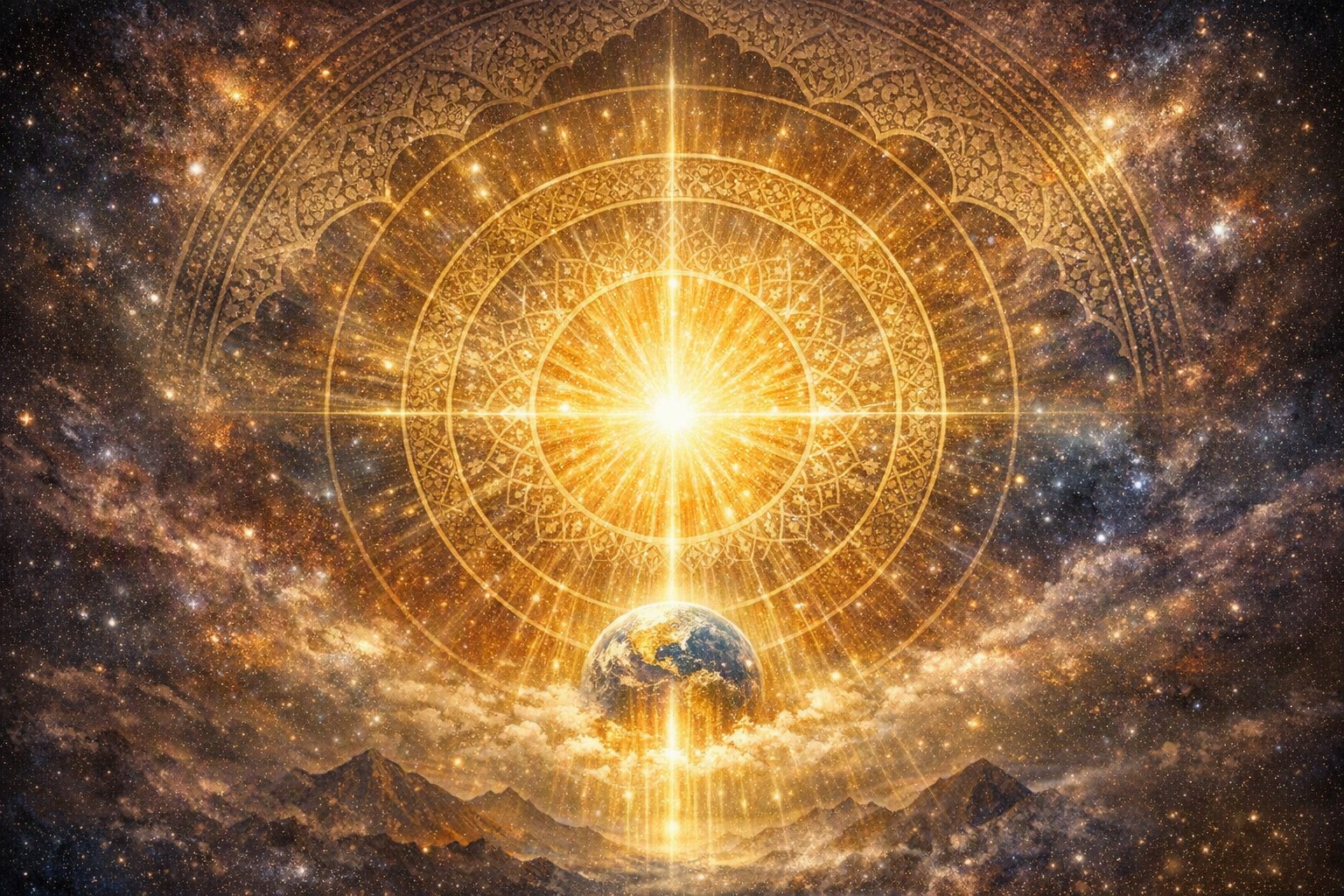
The Theory of Absolute Unity of Being in Ibn Sab'in
The problem of existence is one of the most difficult questions in philosophy. It centers on the relationship between God and the world: Are they completely separate, or is there a deeper connection? The Sufi philosopher Ibn Sab'in developed a unique answer to this question through his theory of the Absolute Unity of Being.
According to Ibn Sab'in, God and the world are not two completely different realities. Instead, there is only one true reality: God. Everything else derives its existence from God and cannot exist independently. In this view, all distinctions and multiplicity ultimately disappear in the unity of the divine reality.
This idea belongs to a long philosophical tradition that includes Brahmanism, Stoicism, Neoplatonism, and certain forms of Sufism. These traditions share the belief that all existence originates from a single divine source. Ibn Sab'in expresses this idea in its most radical form by declaring that “there is no existent except God” or “God alone truly exists.” For him, God is the only infinite and genuine being, and nothing can exist outside of or apart from Him.
To explain this concept, Ibn Sab'in describes three levels of existence:
Absolute Existence: This is God, the one absolute and original reality that encompasses everything.
Conditioned Existence: This refers to the world and all created beings. They do not possess independent existence but derive it from God.
Determined Existence: This consists of God's eternal knowledge of everything that will happen. Its reality is also derived from Absolute Existence.
Because Ibn Sab'in denies the ultimate reality of multiplicity, his philosophy challenges the principles of classical logic, such as identity, non-contradiction, and the excluded middle. These principles depend on the existence of distinct and separate things. However, if all reality is fundamentally one, then apparent differences and contradictions belong only to the level of appearance, not to ultimate reality.
Ibn Sab'in argues that ordinary people believe in multiplicity because they are deceived by the senses and by the outward forms of material things. Mystics, on the other hand, perceive the deeper truth that existence is one, indivisible reality.
This understanding also affects the concept of creation. Rather than accepting the traditional idea that God created the world out of nothing, Ibn Sab'in adopts the theory of emanation. According to this theory, existence flows from God just as light flows from the sun. The world comes forth from the divine source and depends on it completely. As a result, the world's existence is not independent or self-sufficient but derives entirely from God.
Ibn Sab'in's philosophy differs significantly from traditional religious and theological views, which maintain a clear distinction between Creator and creation, cause and effect, and the eternal and the temporal. These distinctions help preserve human freedom and responsibility. By contrast, Ibn Sab'in's doctrine of absolute unity blurs these separations and views all existence as expressions of a single reality.
From the perspective of dualistic religious traditions, this raises important questions about human free will, moral responsibility, and divine justice. If God is the only true reality, then human actions may appear to be extensions of the one divine source. Critics argue that this challenges the foundations of moral accountability. Supporters of Ibn Sab'in, however, maintain that his philosophy offers a different way of understanding human action within the unity of all existence.
In summary, Ibn Sab'in's theory of the Absolute Unity of Being presents a radical form of monism in which God alone possesses true existence. The world and all created beings derive their reality from God, and the apparent multiplicity of existence is ultimately reduced to a single, infinite, divine reality.
Copilot said:
The theory of emanation (fayḍ, الفيض) is a metaphysical doctrine that explains how the world proceeds from God without compromising God's absolute unity and transcendence. It played a major role in Neoplatonism and later influenced many Islamic philosophers and some Sufi thinkers, including Ibn Sab'in.
The Basic Idea
Instead of saying that God creates the world by a deliberate act at a particular moment in time, the theory of emanation holds that:
God is the absolute source of all being.
Existence "flows" or "emanates" from God necessarily, much as light radiates from the sun.
The world depends entirely on God for its existence.
Nothing exists independently of the divine source.
A common analogy is:
The sun does not choose whether to emit light; light naturally radiates from it. Similarly, being flows from the Absolute Reality.
The analogy is imperfect, but it captures the idea that the universe is a manifestation of divine fullness rather than a separate creation produced from outside God.
Emanation versus Creation from Nothing
Creation ex nihilo (خلق من عدم)
In traditional Islamic theology:
God freely wills the creation of the universe.
The world is distinct from God.
The universe begins because God chooses to create it.
Creator and creation remain ontologically separate.
Emanation (الفيض)
In emanationist thought:
All existence derives continuously from God.
The world depends on God at every moment.
The universe is not independent of its source.
The emphasis is on ontological dependence rather than a temporal beginning.
Emanation in Neoplatonism
The clearest philosophical version comes from Plotinus (3rd century CE).
He described reality as flowing from:
The One (the Absolute)
The Intellect (Nous)
The World Soul
The Material Cosmos
Each level possesses less unity and perfection than the one above it.
The process is not a sequence in time but a hierarchy of being.
Ibn Sab'in's Adaptation
Ibn Sab'in takes the idea much further than many philosophers.
For thinkers such as al-Farabi and Ibn Sina, emanation still leaves room for a real distinction between God and the world.
Ibn Sab'in's doctrine of absolute unity of being tends to dissolve that distinction.
In his perspective:
God alone possesses true reality.
The world's existence is derivative and dependent.
Multiplicity is an appearance rather than an ultimate reality.
Whatever existence created things seem to possess is borrowed from God.
Thus, emanation becomes less a description of how a separate world emerges and more a way of explaining why everything that appears to exist is grounded entirely in the one infinite reality.
Why Emanation Matters
The theory attempts to solve a major philosophical problem:
How can an absolutely simple, unchanging, perfect God be related to a changing and diverse universe?
Emanation answers:
The many come from the One.
Diversity derives from unity.
Finite beings depend on infinite being.
The world reflects the divine source without limiting or altering that source.
A Major Criticism
Traditional theologians often objected to emanation:
Blurs the distinction between Creator and creation.
Makes the existence of the world appear necessary rather than the result of divine choice.
Threatens concepts such as moral responsibility and divine judgment.
Supporters, however, argued that it provides a deeper explanation of the world's complete dependence on God and preserves divine unity more consistently than dualistic models.
In Ibn Sab'in's case, the theory of emanation serves as a metaphysical expression of his central conviction: there is only one true reality—God—and everything else derives whatever existence it appears to have from that single, absolute source.
Keep exploring
Discover more stories from Morocco and beyond
Written by
Hamid Mernissi
I was born to travel the world. I am an anthropologist, a Sufi seeker and a student of life.
Comments (1)
A very synthetic text about Ibn Sab'in and his theory of absolute unity of being. It's a good starting point for delving into an author who is often overlooked, despite its importance. Thank you.
Leave a comment