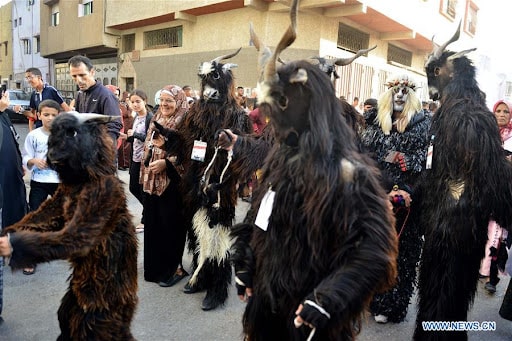
Boujloud: The Wild Spirit of Moroccan Tradition
Brought to you by Hamid Mernissi.
Did you know that Morocco has its version of Halloween? A biblical tradition spanning over 3,000 years.
Every year, in the days following the Eid Al-Adha festival, rural villages and small towns across Morocco come alive with the beating of drums, chants, and the rustling of animal hides. This is Boujloud, a remarkable traditional performance in which men dress in goat or sheep skins, remnants of the sacred sacrifice, and transform into mysterious figures who dance through the streets. These masked performers playfully chase onlookers, create rhythm with sticks or bells, and blur the line between the human and the wild. While often described as “Moroccan Halloween,” Boujloud is a much older and deeper tradition rooted in Amazigh (Berber) spirituality and ancient seasonal rites that celebrate nature, fertility, and community protection.
For anthropologists and cultural travelers alike, Boujloud represents more than just a celebration; it’s a ritual of inversion and renewal. During the festival, the usual social rules are reversed: the trickster becomes the teacher, the wild becomes sacred. This liminal space, where identities are fluid and performance becomes collective storytelling, allows communities to reconnect with their ancestral roots. The strange and sometimes comical behavior of the Boujloud figure serves to protect the village, ward off negative energies, and bring blessings for the new agricultural cycle. It’s a shared moment of cultural memory, performance, and renewal that has survived centuries of change.
Today, Boujloud is celebrated in both its traditional village form and in more organized cultural festivals, such as those in Tiznit, Imilchil, and Agadir, where it draws large crowds and international curiosity. While modernization brings changes, the spirit of Boujloud endures, reminding Moroccans and visitors alike of the profound wisdom and creative energy embedded in these local traditions. For travelers seeking more than surface-level tourism, witnessing Boujloud is a rare chance to experience Morocco’s living heritage, where myth, ritual, and identity dance together in the open air.
The running of Boujloud
This tradition also thrived in Fez as a customary celebration of the tanners' prosperity. Fez was and still is known for its hide tanning tradition. In old times, the tanners used to wear goat and sheep skins and run the narrow streets of the Medina from Chouara Tannery to Nejjarine square to meet with other tanneries, boujlouds, and run hysterically up the hill of Talaa to the main gate of the Medina to assemble in the big square of Boujloud, dancing and chanting the Goubbahi style, a trademark of the tanners of Fez. The Main gate and its square are still called Bab Boujloud to this day.
Keep exploring
Discover more stories from Morocco and beyond
Written by
Hamid Mernissi
I was born to travel the world. I am an anthropologist, a Sufi seeker and a student of life.
Comments
No comments yet. Be the first to share your thoughts!
Leave a comment