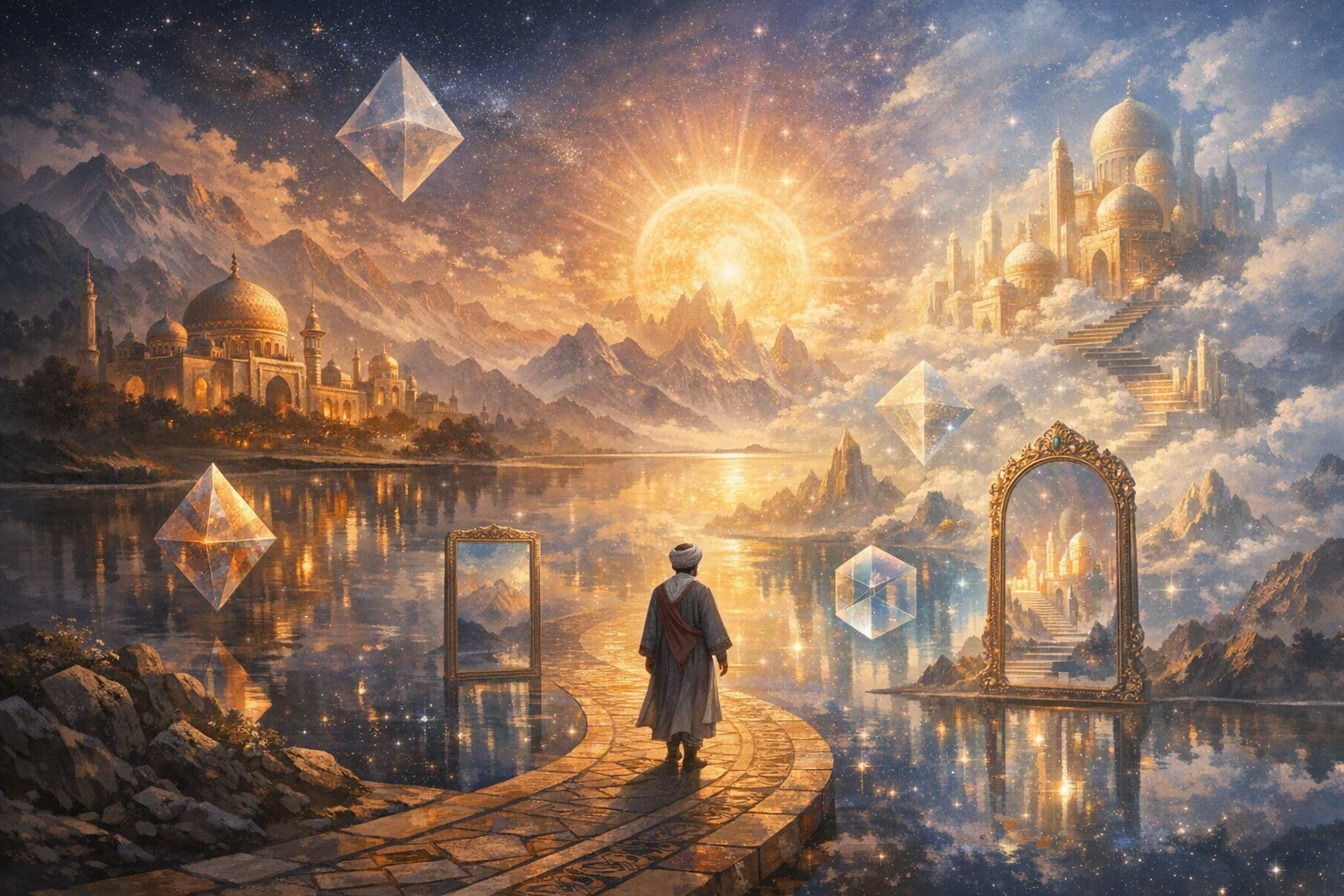
The Theory of the “Suspended Archetypes” in the Metaphysics of Shihab al-Din al-Suhrawardi
Where do the richly detailed images we see in dreams come from? And where do the reflections that appear in mirrors actually exist?
At first glance, these questions may seem simple. Yet they raise a profound ontological problem: What is the nature of the images, forms, and dimensions we perceive, even though they possess no solid material substance? To address this problem, the Persian philosopher Shihab al-Din al-Suhrawardi developed his theory of the “Suspended Archetypes” (al-muthul al-mu‘allaqah), also known as the autonomous imaginal realm. Through this theory, he sought to move beyond the dominant Aristotelian tradition and establish an intermediate realm that bridges the worlds of matter and pure intellect.
A Third Realm Between Matter and Intellect
Classical Greek philosophy generally divided existence into two domains:
The world of tangible, material objects that can be sensed.
The world of abstract intelligible realities grasped by the intellect.
Starting from this dual division, Suhrawardi proposed the existence of a third, intermediate realm.
According to him, forms, shapes, dimensions, and images that do not reside in physical matter, such as dream images, reflections in mirrors, and products of imagination, possess an objective reality of their own. They are not merely impressions stamped onto the human brain. Rather, they exist in an independent ontological domain that he called the World of Suspended Archetypes.
These forms are "suspended" because they do not require a material substrate, body, or physical matter in which to exist, as ordinary objects do. They possess shape, extension, structure, and dimensionality, but lack dense physical substance.
An Analogy: Virtual Reality
A useful modern comparison is virtual reality (VR).
When wearing a VR headset, a person may perceive rooms, landscapes, mountains, colors, and three-dimensional spaces. These environments can be explored and interacted with as though they were real. Yet they possess no physical mass or material atoms within the user's immediate environment.
Suhrawardi's World of Suspended Archetypes resembles a vast repository of forms and images that the human soul can encounter when partially detached from ordinary bodily perception, such as during dreams. It is also the realm from which mirror images and visionary experiences derive.
For Suhrawardi, imagination is not primarily an act of creating images from nothing. Rather, it is an act of perceiving, observing, or connecting with images and forms that already exist in this intermediary realm.
Disagreement with Avicenna
This theory placed Suhrawardi in direct opposition to the Peripatetic (Aristotelian) tradition, especially Avicenna (Ibn Sina).
Avicenna maintained that imagination and mental images are physiological impressions located within specific faculties of the brain. In his account, imagined images depend on bodily organs and cease to exist when the body dies and the brain decays.
Suhrawardi challenged this interpretation. He asked how extremely large images—such as mountains, vast oceans, or entire cities—could be contained as literal impressions within a tiny region of the brain without causing obvious contradictions.
In response to this criticism, he relocated imagination from merely a neurological function within the skull to a distinct ontological realm that human consciousness can access. Thus, for Suhrawardi, imagination is not simply a product of the brain but a mode of perception directed toward an independent world.
This disagreement illustrates a broader philosophical divide:
Avicenna: A physiological theory of imagination, rooted in the functions of the brain.
Suhrawardi: An ontological theory of imagination, rooted in the existence of a separate imaginal realm.
Each position is coherent within its own philosophical framework.
Why the Theory Was Important
For Suhrawardi, the World of Suspended Archetypes was not merely a speculative idea. He considered it a philosophical necessity for explaining phenomena such as:
Divine revelation.
True and prophetic dreams.
The miracles of prophets.
Certain postmortem experiences described in religious traditions.
In this imaginal realm, spiritual and moral realities can appear as visible images, symbolic figures, and visionary experiences. It serves as a stage upon which invisible meanings become perceptible forms.
Conclusion
Suhrawardi's theory of the Suspended Archetypes established what he saw as a bridge between the physical and the spiritual, the earthly and the celestial. By giving imagination an ontological status of its own, he transformed it from a mere mental faculty into a gateway between worlds.
In his philosophy, imagination is not a source of illusion but a profound mode of perception, one that connects the density of matter with the luminosity of higher realities.
Keep exploring
Discover more stories from Morocco and beyond
Written by
Hamid Mernissi
I was born to travel the world. I am an anthropologist, a Sufi seeker and a student of life.
Comments
No comments yet. Be the first to share your thoughts!
Leave a comment