Morocco and the Making of Sovereignty
Memory, Strategy, and the Long Rhythm of Independence
In the memory of modern Morocco, independence is not recalled as a single event, nor as a simple transfer of power. It is understood as a process, one that unfolded through time, shaped by negotiation, sacrifice, and a particular reading of the world.
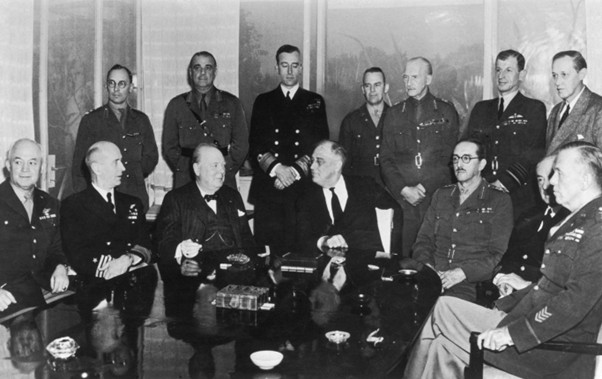
One of the moments often revisited in this narrative is the 1943 Casablanca Conference. There, global strategy, the course of the war, the liberation of Europe, and the reorganization of a world still in conflict were being discussed. For Morocco, the presence of Mohammed V in that context is remembered not only as symbolic but as indicative of a certain awareness: that local futures were increasingly shaped within global dynamics.
The years that followed were marked by tension and transformation. Moroccan soldiers participated in the European theater of war, particularly in Italy and France, contributing to a broader struggle whose outcomes would reshape colonial relationships. Within Morocco itself, the question of sovereignty intensified, leading to confrontations, including the exile of Mohammed V in 1953 and the installation of a rival authority.
In Moroccan collective memory, this period is often narrated through figures who embody resistance. Among them is Mohamed Zerktouni, whose death under pursuit has been remembered as an act of refusal, refusal to yield information, refusal to separate oneself from a cause perceived as larger than individual survival. Such figures occupy a space that is not only historical, but moral, reflecting a conception of dignity intertwined with sovereignty.
Independence, achieved in 1956, did not conclude this trajectory. Rather, it extended it. In the early years that followed, Morocco positioned itself within a wider African context, participating in discussions that would lead to continental cooperation. The meeting of African leaders in Casablanca in 1961, often referred to as the Casablanca Conference, formed part of this movement toward collective reflection on postcolonial futures.
From an anthropological perspective, these moments can be read not only as political events but as expressions of a particular understanding of sovereignty. Sovereignty, in this sense, is not merely territorial control. It is a continuity of intention, a way of situating oneself within shifting global structures while maintaining internal coherence.
This continuity appears in different forms across time. It is evident in diplomatic relations, regional initiatives, and efforts to redefine economic and geographic orientations, including renewed attention to Atlantic connections and African integration. These are not isolated policies, but part of a longer rhythm, a pattern of adapting to changing contexts while drawing on established narratives of independence and agency.
At the same time, it is important to recognize that such narratives are not uniform. They are shaped by memory, interpretation, and the ways societies choose to understand their past. What is emphasized, what is remembered, and what is symbolically linked across generations all contribute to the construction of meaning.
To read Morocco’s modern history, then, is not only to trace events, but to observe how a society relates to them, how it frames its experience of colonialism, resistance, and independence, and how it projects that experience into its present and future.
In this light, sovereignty appears less as a fixed condition and more as an ongoing practice.
A practice of negotiation, of positioning, and of remembering.
Keep exploring
Discover more stories from Morocco and beyond
Written by
Hamid Mernissi
I was born to travel the world. I am an anthropologist, a Sufi seeker and a student of life.
Comments
No comments yet. Be the first to share your thoughts!
Leave a comment