Lamta and the Mountain of Zalagh
On Land, Memory, and the Making of Fez
To stand before the northern horizon of Fez is to face more than a mountain. It is to encounter a layered memory, one in which land, tribe, and city have been woven together over centuries. What the people of Fez call “Lamta” is not simply a geographical designation. It is a name that carries echoes of movement, conflict, settlement, and transformation.
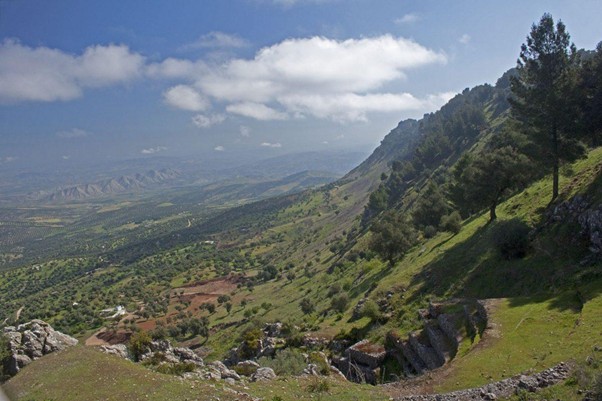
The slopes of Mount Zalagh and the heights of al-Qubab form a natural threshold overlooking the city. Yet this landscape was not always what it appears today. Its history reveals a continuous reconfiguration of people, of power, and of the relationship between human life and the environment.
In its earliest known phase, the region belonged to Amazigh worlds shaped by tribes such as the Barghawata, remembered in older sources under names like the Bercuatae. Later, groups migrating from the eastern regions of North Africa settled here, among them the Maghila and the Aouchchata, leaving traces that would slowly fade as new political and urban centers emerged.
With the arrival of Islam and the campaigns of figures such as Musa ibn Nusayr, the region entered another phase. Fortresses were dismantled, populations reoriented, and over time, the area became increasingly tied to the rise of Fez, especially after the foundation of the Idrisid city. The mountain, once a place of autonomous tribal presence, began to gravitate toward the growing urban center below.
But it was in the 11th century that a decisive shift occurred.
From the southern deserts came the Almoravid movement, carried by Sanhaja tribes whose identity was marked by discipline, mobility, and the distinctive litham that veiled their faces. Among them, the Lamta emerged not as a marginal group, but as a central force. When Yusuf ibn Tashfin entered Fez, it was with the strength of these desert warriors, an encounter remembered as both transformative and violent, marking the end of one order and the beginning of another.
The Lamta did not remain outsiders to the city they helped conquer. Instead, they settled its margins, occupying the northern slopes and transforming them. What had been a military frontier gradually became a cultivated landscape. Water channels were dug, orchards planted, and irrigation systems established. The land was not only controlled but also reworked, shaped into productivity.
The memory of this transformation remains inscribed in the very geography of Fez. Neighborhoods such as Zqaq al-Rumman, with its orchards, and the broader Lamti quarters near Bab Guissa, still carry the imprint of that early presence.
Yet the story of Lamta is not only one of settlement and cultivation. It is also one of the environmental changes.
The forests that once covered these slopes, particularly those of terebinth, gradually receded under the pressure of urban growth and economic demand. In their place, olive trees took root. This shift was not accidental. It reflects an adaptation, a new balance between exploitation and sustainability, influenced perhaps by Andalusian knowledge and agricultural practice. The land, in this sense, became a dialogue between necessity and care.
With the rise of the Almohads, another transformation unfolded.
The Lamta, once warriors at the edge of the empire, were absorbed into the city's life. Their military role diminished, and they turned toward trade, while their lands were entrusted to cultivators, the ʿazzāb, who maintained the agricultural system. Over time, ownership itself shifted, passing into the hands of urban families, including those who arrived from al-Andalus after its fall.
Here, one sees the deeper anthropological movement: a tribe becoming a landscape, and a landscape becoming a city.
But beyond land and labor, another continuity persisted, one that cannot be measured only in material terms.
Places such as Sidi Ali al-Mazali or Sidi Ali al-Chaouch, and even more enigmatic sites like the cave associated with Sidi Chemharouch, reveal how older symbolic worlds were not erased, but reinterpreted. Practices, beliefs, and forms of reverence shifted over time, entering into Islamic frameworks while preserving traces of earlier sensibilities.
This is perhaps the most subtle dimension of Lamta.
Not only a history of conquest or settlement,
but a continuity of meaning.
To speak of Lamta, then, is not merely to recount the story of a tribe. It is to observe how a place transforms across time, how it absorbs migrations, adapts to power, reshapes its environment, and reinterprets its spiritual life.
Mount Zalagh still stands above Fez.
But it no longer belongs to a single people or a single moment. It belongs to a long unfolding, one in which land and memory have become inseparable.
Keep exploring
Discover more stories from Morocco and beyond
Written by
Hamid Mernissi
I was born to travel the world. I am an anthropologist, a Sufi seeker and a student of life.
Comments
No comments yet. Be the first to share your thoughts!
Leave a comment