The Donkey and the Moroccan World
On Labor, Humility, and the Quiet Companionship of Life
In Morocco, the history of labor cannot be written without the presence of the donkey.
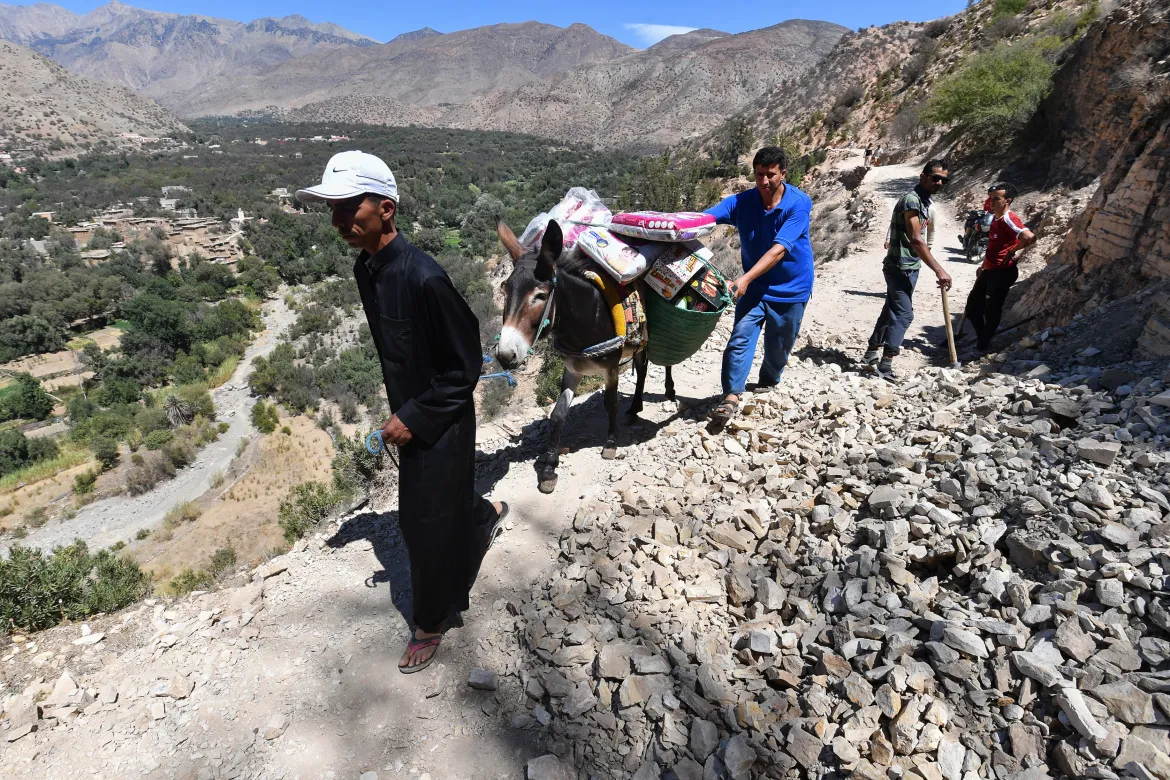
Long before engines and paved roads, in landscapes shaped by mountains, valleys, and winding paths, it was the donkey that carried life forward. In the rugged terrain of the Atlas, where the land resists ease and distance demands effort, the donkey became more than an animal; it became a companion in survival.
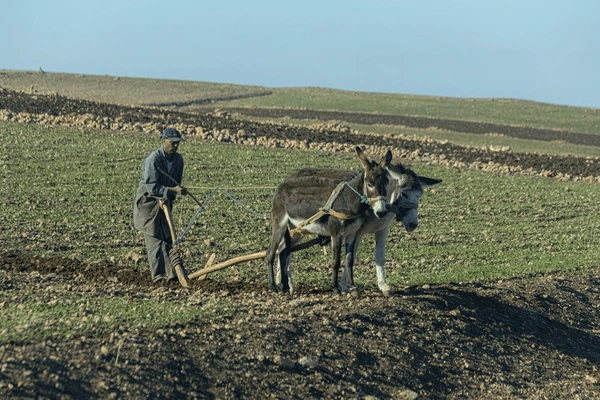
For centuries, in the countryside, plowing was often entrusted to its steady strength. Small farmers, bound to the rhythm of the seasons, relied on its endurance to turn the soil, to open the earth, to begin the cycle of sustenance. It was not speed that mattered, but constancy.
The weekly souk, that ancient institution of exchange and social life, also moved on the back of the donkey. From scattered hamlets and isolated dwellings, farmers would load their produce, grain, vegetables, wool, or olives, and travel along narrow paths toward the marketplace. There, goods would change hands, not always through money, but through barter, through negotiation, through the shared understanding of need.
And when the day was done, the donkey returned, no longer carrying what was grown, but what was needed: tea, sugar, oil, spices, the essentials of the Moroccan kitchen. In this quiet circulation, the donkey became a bridge between production and daily life.
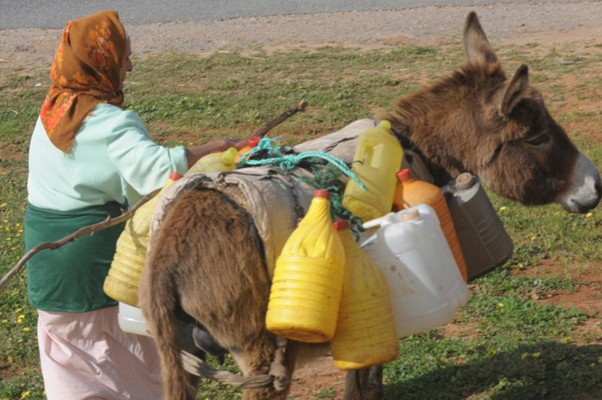
Its presence was also woven into the domestic world. In the mountains, women would walk alongside it to gather firewood, binding the dry branches into bundles that the donkey would carry home. It would also transport water from springs, moving slowly but faithfully between source and household. In these gestures, repeated day after day, one sees not only labor, but a form of shared existence.
The story does not end in the countryside.
In the medieval city of Fez, whose narrow streets still resist wheels and modern vehicles, the donkey was the primary means of transportation. Every sack of grain, every bundle of textiles, every piece of merchandise passed through the arteries of the city on its back. The economic life of Fez, its markets, its workshops, its caravans, depended on this modest animal.
So essential was its role that a whole profession grew around it. The ḥammāla, the porters, formed organized guilds, structured and regulated under an amīn, who ensured the proper functioning of trade. At times, it was said that thousands of donkeys worked daily within the city, resting at night in funduqs, those inns of commerce that sheltered goods, traders, and animals alike.
During peak seasons, when trade intensified, the city would extend its reach beyond its walls. Donkeys from surrounding tribes, such as the Cheraga and the Ouled Jamaa, would enter Fez to support the flow of goods, linking urban demand to rural supply in a living network of exchange.
Beyond the city and the plains, in the most remote and unforgiving terrains, the donkey revealed another of its qualities: its ability to go where others could not. Smaller than the horse, less imposing than the mule, it possessed a tenacity that allowed it to cross steep passes, narrow trails, and unstable ground. It became the vehicle of access, the means by which people reached places otherwise cut off from the world.
It was through such paths that traveling merchants, including the Amazigh Jews known as ʿaṭṭār, carried their goods, spices, cosmetics, and small luxuries to distant communities scattered across the mountains. In these journeys, the donkey was not only a means of transport; it was a connection.
For a long time, Morocco was home to millions of donkeys, and their presence extended beyond the domestic sphere. Trade in donkeys, particularly toward neighboring regions, formed a significant part of the rural economy, reminding us that value is not always found in what is celebrated but often in what is used.
And yet, in language, the donkey has often been treated harshly. To call someone an “ass” is to diminish them, to associate them with stubbornness or lack of intelligence. This contrast between lived reality and symbolic insult reveals something about human societies: we depend deeply on what we do not always honor.
Today, however, a quiet gesture of recognition has emerged.
In Tangier, a museum dedicated to the donkey now stands, a space that invites reflection on this long companionship between human and animal. It does not glorify the donkey in the manner of kings or warriors, but it restores to it a dignity that history has always known, even if language has sometimes forgotten.
Perhaps it is time to reconsider our words.
For in the Moroccan world, the donkey was never merely an animal.
It was labor without complaint, movement without display, and presence without demand.
A silent partner in the making of life.
Long before modern institutions began to speak of animal welfare, Moroccan society had already given form to a quieter ethic of care.
In Fez, near Bab Guissa, people of goodwill established a waqf, a charitable endowment, dedicated to the care of working animals. It was not an act of charity in the narrow sense, but an extension of responsibility toward those who had shared the burden of human life.
Within this gesture, one finds something even more striking: a cemetery reserved for donkeys.
This was not sentimentality.
It was recognition.
An acknowledgment that an animal who had labored, carried, endured, and sustained human life was worthy, at the end of its days, of rest and dignity. In a civilization often described through its monuments and scholars, such acts reveal another layer, one in which mercy extends beyond the human, and where usefulness does not exhaust worth.
Today, as Morocco continues to evolve, this memory takes new forms. Places such as the American Fondouk in Fez remind us that care and recognition can follow utility. What once served can also be protected. What once labored can also be honored.
Keep exploring
Discover more stories from Morocco and beyond
Written by
Hamid Mernissi
I was born to travel the world. I am an anthropologist, a Sufi seeker and a student of life.
Comments
No comments yet. Be the first to share your thoughts!
Leave a comment