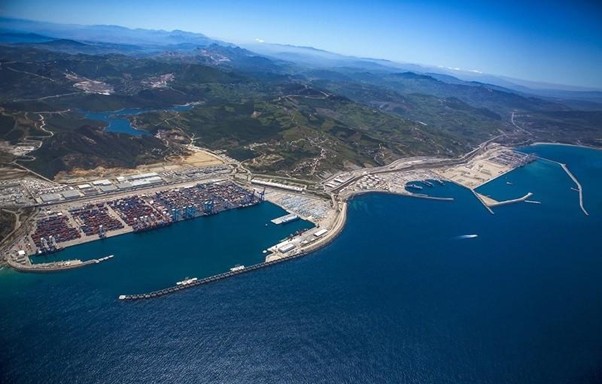
The Strait and the Return of the Sea
On Power, Passage, and the Reawakening of Morocco
At the narrow threshold where the Atlantic breathes into the Mediterranean, the Strait of Gibraltar has always been more than a passage. It is a place where worlds meet, where currents carry not only water, but intention, ambition, and the silent negotiation of power. Today, the roar of container ships and the long wakes of giant vessels redraw this ancient space, tracing new arteries across the globe.
In our time, power no longer speaks only through armies or borders. It moves along routes, through ports, corridors, and flows of goods that bind distant lands into a single, fragile system. Logistics has become a language of sovereignty. To control movement is no longer simply to facilitate trade; it is to participate in the shaping of the world itself.
Morocco, long described as a crossroads, has begun to outgrow that passive image. A crossroads receives; it does not direct. What is unfolding today is something more deliberate, a reorientation in which the Kingdom is no longer only a place of passage, but a place that organizes passage. With the development of infrastructure such as Tangier Med Port, and the emerging horizons of Nador West Med and Dakhla Atlantic Port, the country is quietly repositioning itself in global circulation.
These projects are often described in terms of capacity, tonnage, and connectivity. Yet beneath these measurable dimensions lies another layer, less visible but perhaps more decisive. They signal a shift in posture: from dependency to articulation, from reception to participation. The sea, once perceived as a frontier, becomes again what it has always been in Moroccan history, a field of relation.
Recent disruptions in global trade, pandemics, conflicts, and the instability of distant supply chains have revealed the vulnerability of systems built on distant reliance. In this context, the emergence of a robust maritime infrastructure is not merely an economic strategy; it is a form of resilience. It allows a country to remain present within the flow, rather than be displaced by it.
And yet, beyond strategy, there is a deeper resonance.
For centuries, Morocco stood at the western edge of the known world, the Far Maghreb, al-Maghrib al-Aqsa, a land both distant and connected, looking outward while anchored in its own rhythms. Today, as ships arrive from East and West, from Asia and the Americas, one witnesses not a new role, but the reactivation of an old one. The country becomes a hinge, between continents, between economies, between different tempos of the world again.
But this hinge is no longer silent.
To host circulation is also to shape it. Pricing, standards, and environmental choices are no longer imposed entirely from elsewhere. They are negotiated, sometimes asserted. In this sense, participation in global networks becomes a subtle form of authorship.
For the Moroccan citizen, these transformations may seem distant, confined to ports and industrial zones. Yet their effects travel inward. They influence the cost of goods, the stability of supply, the emergence of new forms of work, and the gradual transformation of regions once considered peripheral into active spaces of production. The hinterland, in this movement, is no longer an afterthought; it becomes part of the same flow.
What we are witnessing, then, is not simply the rise of infrastructure. It is the unfolding of a different relationship between land, sea, and sovereignty. Independence, in the contemporary world, is no longer secured solely by guarding borders. It is sustained by the ability to navigate interdependence without being dissolved within it.
Morocco’s gesture, if one may call it that, is not to withdraw from globalization, nor to submit entirely to its currents, but to inhabit it consciously, to remain within the flow while retaining a measure of orientation.
There is something almost anthropological in this transformation. A society that once organized itself around caravans, routes, and exchanges across desert and sea is rediscovering, in a new form, the logic of circulation that shaped its past. The tools have changed, containers instead of camels, ports instead of caravanserais, but the underlying intuition remains: that movement, when mastered, becomes a source of life.
Perhaps this is the deeper story of the Strait today. Not only a corridor of ships, but a mirror in which a country rediscovers its place in the movement of the world.
Keep exploring
Discover more stories from Morocco and beyond
Written by
Hamid Mernissi
I was born to travel the world. I am an anthropologist, a Sufi seeker and a student of life.
Comments
No comments yet. Be the first to share your thoughts!
Leave a comment