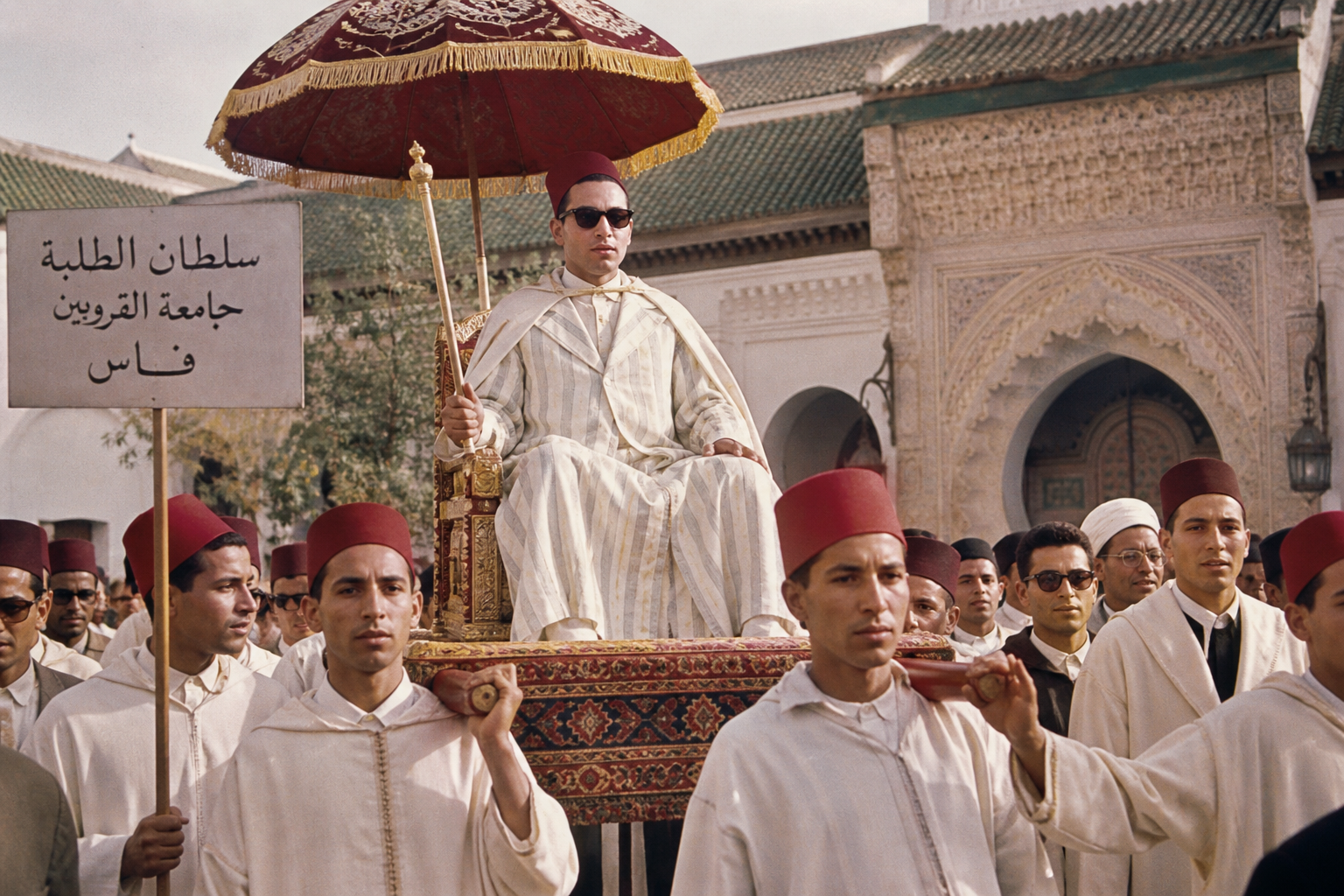
The Sultan of the Talba
When Knowledge Wears the Crown
In Morocco, knowledge has never been a distant virtue.
It is a way of standing in the world.
From an early age, one learns that seeking knowledge is not a choice, but a responsibility, an inheritance rooted in the Prophetic word and carried through generations. In the city of Fez, where learning has long been woven into daily life, this responsibility took on a form at once serious and playful, symbolic and deeply meaningful.
They called it: Sultan al-Talba, the Sultan of the seekers of knowledge.
The talba, students in the modern sense, but in truth seekers on a path, were not merely recipients of knowledge. For one week each spring, they became its embodiment. From among themselves, they would elect a “sultan,” not by lineage or force, but by recognition, a subtle acknowledgment of presence, wit, and learning.
This tradition, which took shape during the reign of Moulay al-Rashid in the seventeenth century, was more than a reward or a celebration. It was a gesture, one that revealed something essential about Moroccan thought: that knowledge is not subordinate to power, but capable of mirroring it, questioning it, even momentarily inhabiting it.
The elected student-sultan would be crowned, surrounded by companions who became his court, his guards, his ministers of a temporary realm. A procession would unfold through the city, echoing the ceremonies of real sovereignty. He would then present himself before the actual sultan to receive the ẓahīr, the symbolic authorization that allowed this parallel order to exist.
For a brief moment, two sovereignties coexisted.
Not in conflict,
But in reflection.
Beyond the city walls, near the riverbanks, the students would set up their encampment. There, they governed themselves. They debated, they organized, they spoke, they enacted the rituals of authority, not as imitation alone, but as understanding. What might appear as satire carried within it a quiet seriousness.
To imitate power is also to reveal it.
The sermons delivered by the student-sultan, often playful and satirical, echoed the structure of the Friday khutba, yet with a tone that allowed critique without rupture. Through humor, they explored the limits of authority, the responsibilities of leadership, and the place of knowledge within governance.
This was not disorder.
It was pedagogy.
A society teaching its scholars that knowledge must not remain confined to books, but must learn to speak to the world, to question it, and to guide it.
Behind this tradition lies a deeper philosophical thread. Moroccan intellectual life has long been shaped by thinkers such as Ibn Rushd and Ibn al-Banna al-Marrakushi, figures whose approaches differed, yet whose presence affirmed the centrality of knowledge in shaping both reason and society. Between rational inquiry and spiritual discipline, a space emerged in which knowledge was not reduced to one form but allowed to expand.
Sultan al-Talba belongs to that space.
It affirms that knowledge is not only accumulation,
but responsibility.
Not only mastery,
But humility before truth.
Even in its origins, whether linked to political gratitude, to moments of alliance, or to episodes of resistance, the tradition grew beyond its circumstances. It became part of the rhythm of Fez, a moment awaited after the rigor of study, where learning breathed, laughed, and reflected upon itself.
In the twentieth century, this practice continued, adapting to changing times. On April 22, 1959, Mohammed V received the Sultan of the Talba, acknowledging once again that knowledge, even in its symbolic form, remains worthy of recognition.
Its gradual disappearance in the late 1960s did not erase its meaning.
For traditions do not end when they cease to be performed.
They remain as questions.
What is the place of knowledge today?
Can it still speak to power?
Can it still guide society, rather than follow it?
To remember Sultan al-Talba is not to recall a curious festival of the past.
It is to be remembered that a civilization once placed the seeker of knowledge at the center of its imagination, if only for a week, so that it would never forget where its true authority lies.
Keep exploring
Discover more stories from Morocco and beyond
Written by
Hamid Mernissi
I was born to travel the world. I am an anthropologist, a Sufi seeker and a student of life.
Comments
No comments yet. Be the first to share your thoughts!
Leave a comment