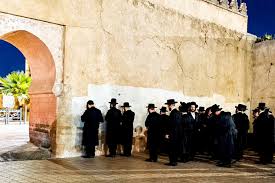
At the Wall of Bab Doukkala
On Gesture, Space, and the Fragility of Meaning
In a world where symbols carry the weight of distant conflicts, even the simplest gestures begin to echo with meanings far beyond themselves. It is easy to react to what we see; it is far more difficult to pause, to listen, and to transform events into understanding.
In the city of Marrakech, where walls are not merely stones but witnesses, an incident unfolded that stirred many emotions and interpretations. A group of Jewish visitors stopped before the wall of Bab Doukkala during their prayer and chose that place to perform it.
At first glance, the act appears simple: travelers pausing to pray. Yet in a land such as Morocco, where space carries layered meanings, no gesture is ever entirely neutral. The question that arises is not only what was done, but how it was read, and why it resonated so deeply.
Anthropology teaches us that space is never empty. A wall is not only a surface; it is memory, history, and belonging. Bab Doukkala is part of a city shaped by centuries of Islamic civilization, but also by the presence of Jewish communities who lived, prayed, traded, and shared life with Muslims over generations. This shared past is not theoretical; it is lived, remembered, and carried in language, customs, and daily life.
For this reason, the act of praying before a wall, any wall, can take on symbolic dimensions that exceed the intention of those performing it. Some observers perceived in this gesture an echo of another place, another wall, another history far from Morocco. Whether this parallel was intended or imagined, it reveals something essential: that symbols travel and can awaken sensitivities shaped by distant conflicts.
Yet here, one must be careful.
To interpret a gesture is legitimate.
To transform it into a judgment of entire peoples is not.
Morocco has long been a land where religious coexistence was not an abstract principle, but a lived reality. Jews were not strangers here; they were part of the social fabric, sharing the same spaces of life, the same markets, the same hardships, and celebrations. This history of coexistence should not be erased by the tensions of the present, nor should it be instrumentalized in ways that distort its spirit.
At the same time, it would be naive to ignore the weight of contemporary realities. The world we live in today is marked by deep fractures, and symbols associated with distant conflicts often carry emotional and political charge wherever they appear. What may seem to some as an innocent act can be perceived by others as a provocation, especially when it resonates with unresolved wounds.
Between innocence and provocation, there is often a space of misunderstanding.
It is in this space that reflection becomes necessary.
Rather than asking only whether the act was right or wrong, we may ask: what does this reaction reveal about us? About the fragility of shared spaces? About the difficulty of separating spiritual gestures from political meanings in a world where images and symbols circulate without context?
As a Sufi, one is reminded that intention (niyya) belongs to the heart, and the heart is known only to God. What is visible to us is the act; what is hidden is its origin. Judgment, therefore, must remain humble.
As an anthropologist, one understands that meaning is not fixed. It is produced in the encounter between gesture and context, between action and perception. The same act, in another place or another time, might pass unnoticed. Here, it did not.
This incident, then, should not be read as a rupture, but as a moment that reveals the delicate balance of coexistence. It reminds us that shared space requires awareness, that history cannot be ignored, and that sensitivity to place is part of respect.
Morocco’s strength has never been in the absence of difference, but in its ability to hold difference without dissolving into hostility. This requires not only tolerance, but discernment, the ability to distinguish between individuals and ideologies, between gestures and intentions, between memory and projection.
If there is a lesson to draw from this moment, it is not one of accusation, but of responsibility.
To those who visit:
to understand the weight of the places they enter.
To those who witness:
to guard against the temptation of generalization.
And to all:
to remember that coexistence is not given once and for all.
It is a practice, fragile, demanding, and always in need of renewal.
Keep exploring
Discover more stories from Morocco and beyond
Written by
Hamid Mernissi
I was born to travel the world. I am an anthropologist, a Sufi seeker and a student of life.
Comments
No comments yet. Be the first to share your thoughts!
Leave a comment