Morocco at the Philadelphia Centennial Exhibition of 1876
In 1876, as the United States celebrated the centennial of its independence with the grand Philadelphia Centennial Exhibition, one nation arrived carrying not the machinery of the Industrial Revolution, but the timeless elegance of an ancient civilization. That nation was Morocco.
Amid the bustling halls of the exhibition, where visitors marveled at the latest technological inventions and industrial achievements of the modern age, the Moroccan pavilion offered something entirely different: a journey into a world shaped by centuries of craftsmanship, artistry, and cultural refinement. It brought with it the fragrance of distant souks, the beauty of Andalusian-inspired architecture, and the enduring traditions of a kingdom whose history stretched far beyond the young republic it had come to honor.
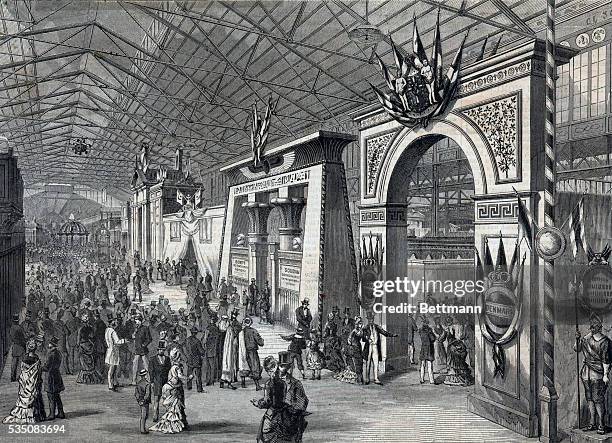
This rare photograph captures a glimpse of that remarkable presence. Moroccan artisans and craftsmen can be seen within an authentic traditional setting, surrounded by finely crafted ceramics, decorative metalwork, woven textiles, and intricate geometric patterns that reflected the extraordinary sophistication of Moroccan craftsmanship in the nineteenth century. Every object displayed told a story, not merely of skill, but of a civilization where art and daily life had long been inseparable.
Morocco's participation was far more than a ceremonial gesture. It was a confident presentation of a nation deeply rooted in history and enriched by the meeting of multiple worlds. Moroccan culture stood at the crossroads of Africa, Andalusia, the Mediterranean, and the Arab-Islamic East, blending these influences into a distinctive identity that fascinated American and European visitors alike.
For many Americans, the Moroccan pavilion became their first window into Moroccan life. Through handwoven carpets, engraved brasswork, the celebrated ceramics of Fez, embroidered garments, carved wood, and traditional architecture, visitors encountered a culture both exotic and refined. The artisans themselves became living ambassadors, demonstrating techniques passed down through generations and preserving traditions that had flourished for centuries.
World fairs of the nineteenth century served as stages upon which nations presented themselves to the world. In Philadelphia, Morocco distinguished itself not by industrial power but by cultural depth. While others displayed machines, Morocco displayed craftsmanship. While others celebrated progress, Morocco reminded visitors of the enduring value of beauty, artistry, and heritage.
This image preserves a remarkable historical moment: Morocco standing proudly among the nations of the world at one of the greatest international exhibitions of the nineteenth century. Long before the age of globalization, long before modern tourism connected distant cultures, Moroccan artisans crossed oceans to share their traditions with a curious world.
Their presence reminds us that the Moroccan craftsman was never merely an artisan. He was a guardian of memory, a keeper of tradition, and an ambassador of Moroccan identity whose work carried the soul of a nation far beyond its borders.
Keep exploring
Discover more stories from Morocco and beyond
Written by
Hamid Mernissi
I was born to travel the world. I am an anthropologist, a Sufi seeker and a student of life.
Comments
No comments yet. Be the first to share your thoughts!
Leave a comment