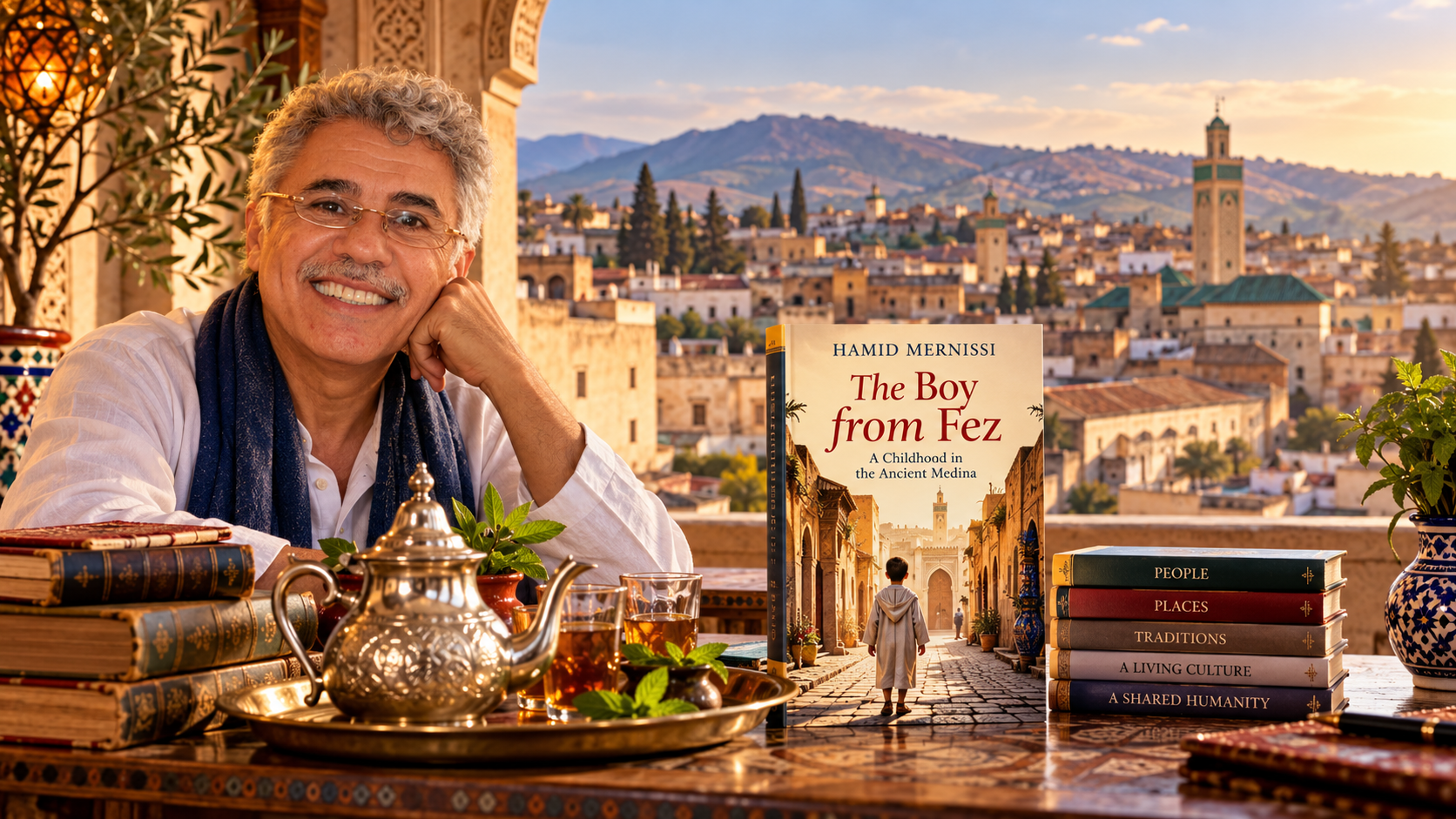
The Boy from Fez: Morocco, Told from Within
An anthropologist's childhood, a civilization remembered, and a human story for everyone.
There are places in this world that have been visited, photographed, painted, studied, and described for centuries, yet whose people have not always been given the opportunity to tell their own stories.
Morocco is one of those places.
For generations, travellers have crossed its mountains, wandered through its ancient cities, admired its architecture, listened to its music, and marvelled at its traditions. Some came with open hearts and curious minds. Others arrived carrying images of a mysterious and exotic land, and departed having found little more than what they expected to see.
But behind every carved doorway, every fountain, every workshop, and every narrow street, there is another Morocco. A Morocco that lives, laughs, struggles, remembers, loves, and teaches.
That is the Morocco I knew as a child.
I was born in Fez, in a world where grandmothers were guardians of wisdom, craftsmen were teachers, neighbourhoods were classrooms, and ordinary people carried extraordinary knowledge without ever thinking of themselves as scholars.
I did not know that I was growing up in the heart of a civilization. I was simply a boy, curious, mischievous, sometimes obedient, often otherwise, discovering life among people who would become my first teachers.
My grandmother Lalla taught me lessons that no university could have offered. The craftsmen showed me that dignity was inseparable from skill. The orchards taught me that water was not merely a resource but a responsibility shared among neighbours. The streets of Fez introduced me to friendship, courage, generosity, injustice, humour, and the complicated art of becoming human.
Only much later, after studying anthropology and travelling across the world, did I begin to understand what those experiences had given me.
I had spent years studying cultures, yet the first society I had ever encountered remained my greatest classroom.
And so I returned to it—not with a research questionnaire, but with memory.
I wanted Morocco to tell its own story, from within.
Not through an exotic portrait designed to satisfy the imagination of a visitor. Not through a catalogue of monuments, customs, and picturesque scenes. But through the lives of the people who made those places meaningful.
I wanted to remember the human beings behind the civilization.
That is how The Boy from Fez came into being.
It is a memoir of my first twelve years, but I hope readers will discover something more within its pages: a kind of anthropology from within, where culture reveals itself through lived experience rather than distant observation.
I wrote it with particular affection for travellers.
For much of my life, I have accompanied visitors through Morocco, introducing them to its history, landscapes, traditions, and people. I have seen how a journey can transform someone's understanding when curiosity replaces assumption and conversation replaces spectacle.
I believe travellers can become some of the finest ambassadors of Moroccan culture—not because they repeat what they have been told, but because they have encountered its people, listened to their stories, and discovered something for themselves.
Perhaps this book can help them begin that journey before they arrive.
I also wrote it for Moroccans, wherever they live.
Our inheritance is not confined to palaces, mosques, manuscripts, and monuments. It also survives in the wisdom of our grandparents, the dignity of our craftsmen, the songs of our mothers, the rituals of our homes, and the everyday relationships through which generations learned to live together.
Some of these treasures are disappearing quietly. Others remain among us, waiting to be recognized.
I wanted to gather what I could remember before time carried it farther away.
But there is another reason I wrote this book, one that I discovered gradually as the stories came together.
Everyone has a Fez of their own.
My Fez has its ancient walls, its fountains, its orchards, its craftsmen, and the voices of people I loved. Yours may be a village, a neighbourhood, a farmhouse, a street, or a home on the other side of the world.
Yet somewhere in those places, we learned our first lessons about love, fear, friendship, belonging, dignity, and loss.
The landscapes may differ, but the human experiences often recognize one another.
And perhaps that is where the most meaningful bridges between cultures begin: not when we pretend that our differences do not exist, but when we discover the humanity that lives within them.
I am grateful to the people who inhabited my childhood. Some are no longer here to tell their stories. Others may never have imagined that their ordinary lives would one day travel beyond the walls of Fez.
I am grateful, too, for the tools and companionship that helped me bring these memories into a book, including the assistance of OpenAI in the editorial process. But the experiences, the people, and the memories belong to the life I lived and to the inheritance I received.
If this book finds readers across the world, I hope they will encounter Morocco with greater understanding. I hope Moroccans will recognize something precious in their own cultural memory. And I hope readers who have never visited Fez will discover, somewhere among its streets and stories, a doorway leading back to their own childhood.
The Boy from Fez is now published by Mernissi Publishing and available internationally through Amazon.
I offer it with gratitude to those who came before me, affection for those who walk beside me, and hope for those who will come after us.
The boy lived the story. The man preserved it. Now the world is invited to discover it.
Hamid Mernissi
Author of The Boy from Fez
Keep exploring
Discover more stories from Morocco and beyond
Written by
Hamid Mernissi
I was born to travel the world. I am an anthropologist, a Sufi seeker and a student of life.
Comments
No comments yet. Be the first to share your thoughts!
Leave a comment